
Would you tell America to give up its own land?
Imagine your country was invaded. Now imagine the rest of the world deciding how much of it you should surrender.
 Macjam14 min read
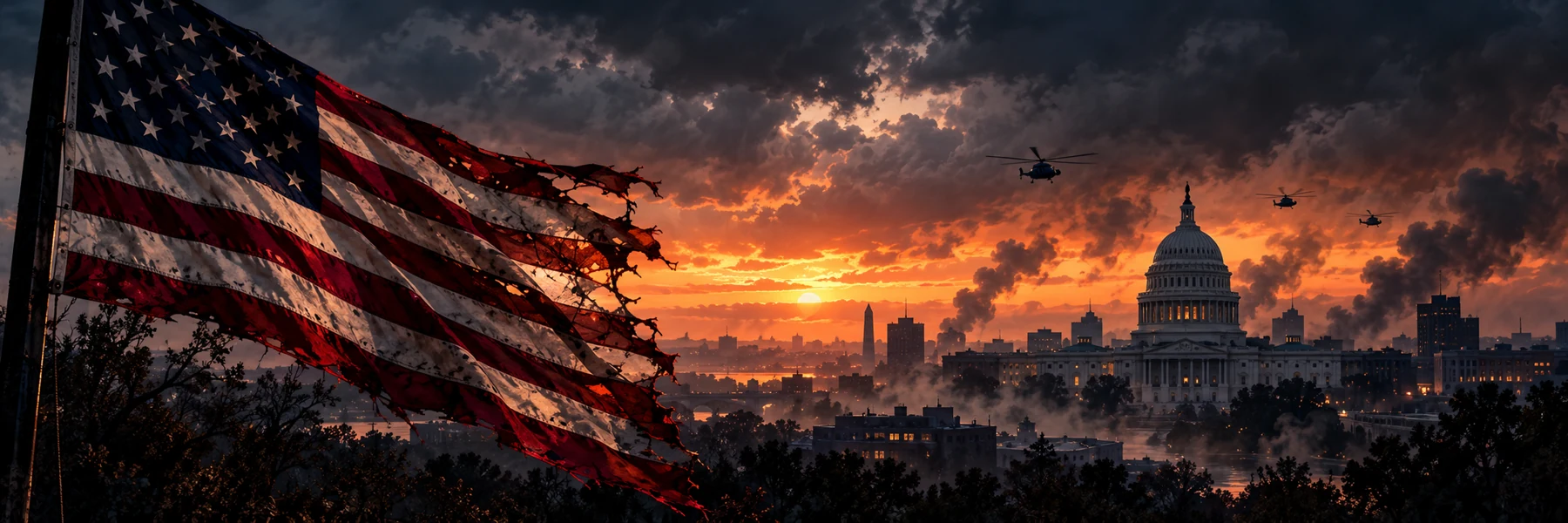
Imagine Mexico has invaded the United States. Significant parts of Texas, New Mexico and Arizona are under occupation. People have been driven out of their homes. Families are separated. Towns that were American a few years ago are now controlled by another country’s soldiers.
America fights back.
At first, Europe helps. European governments send weapons, provide intelligence and promise that they will stand with the American people. They say that borders cannot simply be changed by force.
But the war drags on. Elections happen. Different politicians come into power. Supporting America becomes expensive and politically inconvenient.
Gradually, the conversation changes.
European politicians start asking why their taxpayers should keep paying for America’s war. Commentators talk about how much money has already been sent. People suggest that America’s government is corrupt, that its leaders are profiting, that perhaps the country is not worth supporting after all.
Then comes the accusation:
“America doesn’t want peace.”
Apparently, the problem is no longer that Mexico invaded. The problem is that Americans will not accept Mexico keeping what it took.
How would that feel?
Of course, this is a fictional scenario, not a prediction about Mexico. For the purpose of this thought experiment, imagine that America’s military advantages and existing alliances haven’t been enough to end the occupation.
The question isn’t whether this particular invasion is likely.
It’s how you would feel about the decisions being made if your country were the one under attack.
It is not “just land” when it is yours
Suppose European leaders announce that they have found a sensible compromise.
Mexico keeps the territory it occupies. A ceasefire line cuts through the United States. Americans who fled those areas may never be able to return safely. People who stayed are left under Mexican control.
Europe calls it a realistic solution.
Would you immediately agree that this was fair? Would you look at the place where you grew up, where your parents still live, or where your family is buried, and think that losing it was an acceptable inconvenience so everyone else could move on?
I doubt many people would find that easy.
That does not mean every American would support fighting indefinitely. Some would believe a ceasefire was the least terrible option. Others would think continuing the war offered a better chance of securing their future. There would be painful disagreements, and none of those choices would be free of consequences.
But even an American who accepted a ceasefire might still resent being told that the invasion was now their fault because they had resisted it.
They might also object to hearing their home described as a bargaining chip.
When you live somewhere else, territory can become a percentage on a map. When you live there, it is your house, your work, your neighbours and the institutions that shape your life.
A change in who controls it can determine whether you can speak freely, keep your property or safely criticise the people governing you.
Occupation is not simply a different flag above the same town hall.
So when somebody suggests America should “just give up some land”, wouldn’t you think the word just was doing an awful lot of work?
Would they use it so casually if the people being left behind were their neighbours?
When the invaded country becomes the problem
Now imagine European leaders begin negotiating with Mexico about America’s future without America at the table.
Talking to an enemy is not inherently wrong. Diplomacy requires contact, and preliminary discussions do not automatically amount to betrayal.
But suppose those discussions start producing expectations about which American territories should be surrendered, which alliances America should be allowed to pursue, and how much military capability it should retain.
When Washington objects, European politicians complain that America is being difficult.
From an American perspective, the response would surely be understandable:
You’re discussing our country, our security and our people. Why are we the inconvenience?
Perhaps that last part sounds familiar.
On 18 February 2025, American and Russian officials met in Saudi Arabia for discussions concerning the war in Ukraine. Ukrainian representatives were not present.
Ukraine objected to being excluded from discussions about its future. President Trump subsequently criticised Ukraine’s position and suggested that it should never have started the war, despite Russia having launched the full-scale invasion in February 2022. [1]
And suddenly, our fictional scenario isn’t quite so unfamiliar.
The countries are different. Their military capabilities, relationships and treaty obligations are different. But the underlying questions are remarkably similar.
How should a country react when others begin discussing its territorial future without its participation?
How should it feel when years of resistance are increasingly characterised as an unwillingness to make peace?
And how should it respond when the countries helping it begin treating that assistance as a reason to dictate the terms of its future?
There is another reason the question of territory matters.
In Ukraine, the consequences of occupation are not hypothetical. UN human rights investigators have documented arbitrary detention, torture, enforced disappearances and the suppression of Ukrainian identity in Russian-occupied territory. [2]
For the people living there, the question of who controls their home is far more than a dispute over lines on a map.
And that brings us back to something that bothers me about how these wars are discussed.
The invading country decides to attack. It decides to occupy territory. It continues making demands.
Yet somehow, the invaded country becomes the obstacle because it will not agree to those demands quickly enough.
Of course, an invaded country’s decisions can be criticised. Its leaders can make mistakes. A military strategy can fail. A proposed settlement can deserve serious consideration.
But those arguments need to be made honestly.
“Your strategy is unlikely to succeed” is a different claim from “you do not want peace”.
One is an assessment that can be debated. The other turns resistance into a moral failing.
I don’t think Americans would appreciate that distinction being ignored if it were their country under occupation.
An excuse does not become convincing because it contains a fact
Imagine Mexico explains the invasion by saying it is protecting people of Mexican heritage.
Its government points to Spanish-speaking communities in the American southwest. It says those communities are being mistreated. It uses images of immigration detention and deportation as evidence that intervention is necessary.
Perhaps some of the incidents it highlights genuinely deserve criticism. Perhaps there are real injustices that Americans should address.
Would that make you accept the invasion?
Or would you say that concerns about people’s treatment do not give a neighbouring government permission to take over the places where they live?
There are distinctions here that should be obvious. Speaking Spanish does not automatically make someone a Mexican citizen. Having Mexican ancestry does not mean someone wants to be governed by Mexico. A person’s language and family background do not allow a foreign government to decide their political allegiance for them.
Apply that same reasoning to Russian-speaking Ukrainians.
Their language does not, by itself, tell us what country they want to belong to. Nor should another government get to substitute its own claim of ownership for their wishes.
The point is not that every concern must be fabricated before an invasion becomes wrong. The point is that a real concern can be exploited to justify something it does not justify.
Consider the argument about Nazis.
Imagine Mexico repeatedly broadcasts footage of American neo-Nazis. European commentators pick it up. Soon, every discussion about helping America returns to the same images, the same extremists and the same suggestion that the American government needs to be removed.
You would not have to deny that those extremists existed to reject that portrayal of your country. You could condemn them completely while also saying that they did not represent you, your neighbours or the entire population.
Ukraine deserves that distinction too. Azov’s far-right origins are real and should not be airbrushed out of its history. But that is not evidence that Ukraine as a whole is a Nazi state. The US Holocaust Memorial Museum explicitly rejected Putin’s claim that democratic Ukraine needed to be “denazified”. [3] [4]
We should take extremism seriously wherever it appears. We should also recognise what happens when the worst people in a country are used to define everyone in it.
If someone did that to America while Americans were being invaded, I suspect the manipulation would be much easier to spot.
Your government is not the same thing as your country
Then there is corruption.
In our hypothetical, European commentators begin saying that aid is disappearing. Some claim it is going into Donald Trump’s pocket. Others repeat the allegation without knowing whether it is true.
Imagine hearing that while your town is being bombed.
You might support Trump. You might despise him. Either way, would you think an allegation about his conduct meant your community no longer deserved protection?
There is a perfectly reasonable response to concerns about corruption: investigate them. Require evidence. Improve oversight. Prosecute wrongdoing. Change the way assistance is delivered where necessary.
What does not automatically follow is that the people living in the invaded country should be abandoned.
Even proven misconduct by a government official would not make the invading army less of a threat to the family down the road. It would not transfer ownership of their home to the invader.
Nor does “we cannot fully account for this” automatically mean “the president stole it”. Those are different claims, and anyone making the second needs evidence for the second.
I am not arguing for unquestioning trust in Ukraine’s leadership, or in anyone else’s. Supporting a country’s right to defend itself should not require pretending its government is flawless.
But I would apply that standard to America as well.
Americans should not have to demonstrate that every politician, contractor and military unit is beyond criticism before their country deserves sympathy. Neither should Ukrainians.
Support is not a blank cheque. It is not ownership, either
The strongest objection to this analogy is not that every criticism of Ukraine is secretly Russian propaganda. It plainly would not be.
It is that other countries have their own responsibilities.
European taxpayers in this hypothetical would have legitimate concerns about spending, their own public services, military readiness and the risk of a wider war. Helping America could not mean ignoring every consequence for themselves.
That is fair.
But now imagine some European governments move from questioning the cost to treating their assistance as authority over America’s future.
“We have already given you so much. You should accept the deal.”
Would Americans feel that gratitude required them to agree to whatever those governments proposed? Or would they think it was possible to appreciate the help while still objecting to a settlement that left their families exposed?
Helping someone does not mean every later judgement you make on their behalf must be right.
The same applies to how the war is fought. Imagine American forces strike military facilities inside Mexico that are being used to sustain the invasion. European politicians become more angry about those strikes than about the occupation itself.
Americans would still have responsibilities towards civilians. Being invaded would not give them unlimited permission to do whatever they wanted. But they would reasonably ask why the aggressor’s ability to continue attacking was being treated as something they should leave undisturbed.
Now add another layer: some of those same European governments keep buying Mexican oil, providing revenue to the state occupying American territory, while explaining that doing otherwise would be too expensive.
How convincing would their lectures about the need to end the war feel then?
You could understand that economic pressures were real and still think their priorities were badly wrong.
And if Americans became bitter towards Europe after all this, would that really be surprising? Suppose you watched politicians praise your courage at the beginning, grow tired of helping, repeat the invader’s arguments, and then accuse you of being ungrateful when you objected.
That would damage trust.
I think anyone who cares about strong alliances should take that possibility seriously, rather than assuming that the country dependent on help is the only one whose behaviour matters.
Yes, NATO is a real difference
America is a NATO member. Ukraine is not. That changes the formal obligations of their partners, and it would be dishonest to pretend otherwise. NATO’s collective-defence commitment applies to its members; Ukraine is not covered by it. [5]
Article 5 also deserves to be described accurately. It requires allies to assist an attacked member, while allowing each to determine the action it considers necessary, including the use of armed force. It is not a script prescribing an identical military response from every country. [6]
So yes, the treaty position in this hypothetical is different.
But that does not dispose of the underlying question. It explains why America would have a different formal claim to assistance. It does not explain why Ukrainians should feel less attached to their homes, less concerned about occupation or less entitled to have their future taken seriously.
Ukraine’s history also includes security assurances, although those must not be confused with NATO membership. In the 1994 Budapest Memorandum, as Ukraine committed to eliminating the nuclear weapons on its territory and acceding to the Non-Proliferation Treaty as a non-nuclear-weapon state, Russia, the United States and the United Kingdom reaffirmed commitments to respect its sovereignty and existing borders and refrain from threatening or using force against it. The memorandum did not promise an automatic American or British military response to any invasion. [7]
We should not invent a guarantee that was never given. Equally, I do not think the difference between an assurance and a military guarantee makes the credibility of those assurances irrelevant.
What lesson do we want countries to draw about giving up dangerous weapons and relying on international commitments?
There is also a separate NATO-related argument: that a neighbouring country may feel threatened by another country’s alliances.
Put that into the hypothetical too. Mexico says America’s relationship with Europe threatens its security and insists that Washington must change course.
That concern could be discussed. It could form part of diplomacy. But would Americans accept that Mexico therefore had the right to dictate their foreign policy or occupy their territory?
Understanding why a government feels threatened is not the same as accepting everything it chooses to do about it.
Wanting peace is not the same as accepting any terms
None of this means Ukraine should fight forever, regardless of the cost.
I do not think people watching from the safety of another country should casually demand that Ukrainians keep dying to satisfy our idea of a perfect outcome. Their lives are not ours to spend.
But that principle has to work both ways. We should not casually demand that they accept occupation to satisfy our desire to stop hearing about the war either.
There are serious reasons to support negotiations. A ceasefire can save lives. Accepting a temporary military line does not necessarily mean recognising it as a legitimate international border. A country can conclude that it cannot recover territory now without agreeing that the territory rightfully belongs to the invader.
Those distinctions matter. Not every proposal to stop the fighting is surrender, and not everyone who supports negotiations is indifferent to Ukraine.
In March 2025, Ukraine itself expressed readiness to accept a proposed interim 30-day ceasefire, conditional on Russian acceptance and simultaneous implementation. The joint US-Ukrainian statement also announced the resumption of American security assistance and intelligence sharing. That alone should make us more careful about reducing Ukraine’s position to a blanket refusal of peace. [8]
The difficult question is what makes a proposed peace sustainable.
Return to America. Suppose Mexico offers to stop fighting while retaining the territory it occupies. You might reluctantly decide that accepting a ceasefire is necessary. But you would still want answers.
What happens to the people under occupation? Can displaced families return? What military capability can America retain? Who will help enforce the agreement? What happens if Mexico attacks again?
Asking those questions would not mean you wanted more Americans to die. It could mean you were trying to prevent another war.
We cannot know with certainty that every concession would lead to another invasion. But neither can we assume that an agreement would permanently solve the problem simply because someone announced it as a peace deal.
The risks of continuing the war are real. So are the risks of a settlement that fails. A serious argument has to consider both.
And the people who will live with those risks deserve more than being told that they are difficult.
The same standard
I am not suggesting that America speaks with one voice, or that Europe does.
This is not an argument that Americans are bad and Europeans are good. I would object just as strongly to European governments applying these double standards. Nor do I think an ordinary Russian person should be treated as interchangeable with the decisions of the Russian state.
What bothers me is the way changing the country’s name can change what people are willing to excuse.
Defending your own home is understandable, but defending someone else’s becomes stubbornness. Distrusting an army that invaded you is common sense, but Ukrainians are expected to set that distrust aside. Wanting a say in your country’s future is sovereignty until it inconveniences the people negotiating over it.
You do not need to believe every Ukrainian decision has been right to recognise that inconsistency.
You can support negotiations. You can question spending. You can believe some military objectives are unrealistic. You can argue that a particular ceasefire offers the best available chance of saving lives.
But make those arguments with the same seriousness you would expect if your family lived on the other side of the proposed line.
Do not treat the loss as trivial because it is not yours. Do not assume that wanting your country back means wanting war. And do not turn the people resisting an invasion into the villains simply because their resistance has become inconvenient.
That is really the point of this whole thought experiment.
I am not asking Americans to care less about their own country.
I am asking them to recognise that Ukrainians are allowed to care about theirs just as much.
Something to think about?
A small heart if this resonated. A link if it might resonate with someone else.
Sources & references 8 sources
- Three weeks that changed the world: how Trump turned against Ukraine and Europe ↗Reuters · 10 March 2025
- Human rights situation during the Russian occupation of territory of Ukraine and its aftermath ↗UN Human Rights Office · March 2024
- US clears way for Ukrainian military unit to use American weapons ↗Reuters · 11 June 2024
- Museum condemns Russia’s invasion of Ukraine and the exploitation of Holocaust history ↗US Holocaust Memorial Museum · 24 February 2022
- NATO member countries ↗NATO · Official membership information
- The North Atlantic Treaty, including Article 5 ↗NATO · 4 April 1949
- Budapest Memorandum on security assurances ↗UN document A/49/765–S/1994/1399 · 5 December 1994
- Joint US–Ukraine statement on the Jeddah talks ↗Reuters · Statement text · 11 March 2025

Macjam’s Uplink is my little corner for sharing some of that. Thoughts, opinions, observations, and the occasional lengthy ramble about something that’s caught my attention. Nothing formal, just me putting things out into the world.
More about me ↗